



Estimated reading time: 8 minutes
A cheap lead is not always a good lead, and that sounds obvious. But a lot of paid media optimization still works as if it were not true. Example: An insurer sees a calculator entry, a bank sees an account application, the ad platform sees a conversion and starts optimizing for more of them.
Great 😉
But the business might care about something that happens much later:
- a signed policy
- a funded account
- a profitable customer
- customer lifetime value
- a specific product mix
This is where budget allocation in banking and insurance gets interesting. I wrote about the general problem in Attribution Without Allocation Is Just Reporting: measurement only becomes useful when it changes where the money goes.
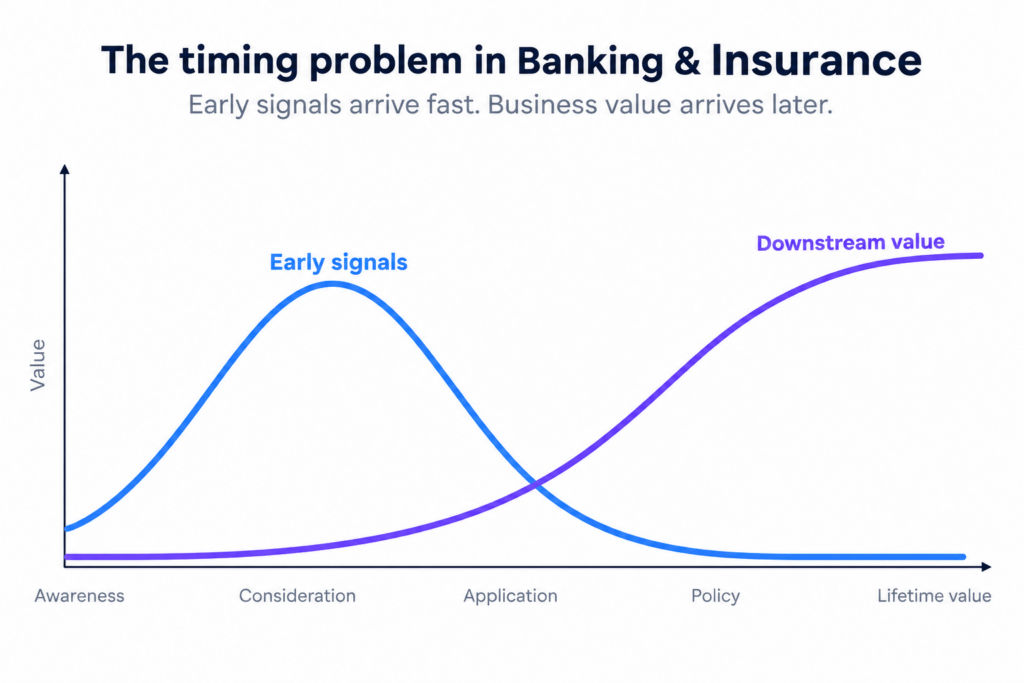
For banks and insurers, there is one big challenge: media activity (impressions, clicks, or likes) happens today, but the business outcome often arrives weeks or even months later. The reason is simple: you’re not waking up, opening your TikTok, and deciding directly after you see the ad that you now want to open a new account with a bank you never saw. Or insure your house with this insurance because it just makes sense. These decisions need time, multiple touchpoints, trust, and repetition.
That is exactly why measurement in banking and insurance is so difficult, and if you optimize for the wrong signal, you can become very efficient at generating the wrong outcome.
The real KPI is usually further down the funnel
Imagine two campaigns.
- Campaign A generates applications for EUR 40.
- Campaign B generates applications for EUR 55.
Where to put more money? It’s an easy decision, right? Put more money into A.
Well: Not necessarily.
What if 25% of the applications from B become customers, while only 10% from A do 3 months later?
Suddenly the more expensive campaign is the better business investment.
This is why you should always start with the final outcome and work backward from the KPIs you need as a business to design and set up your performance media setup.
For an insurer this could be:
- policy purchases
- annual premium value
- qualified calculator entries
- customer lifetime value (i.e. CLV/ACV/LTV)
For a bank/financial service this could be:
- opened accounts
- accounts with regular salary
- accounts with investments
- qualified applications for loans
- account deposits
- long-term customer value (CLV/ACV/LTV)
Then you need to figure out which signals are good enough to use as leading indicators. The most important word here is leading, because you will never know with certainty today which early signal will result in a sale three months from now. (Yes, even if you use MMM, econometrics, MTA, etc., these signals are all historic and leading). Such a proxy is useful when it helps us make an earlier decision, it only becomes dangerous when we forget that it is only a proxy 😉
Conversion lag changes how fast you can trust the data
Let’s make an example with insurance and conversion lag, to make it straightforward:
- A user sees an ad today on TikTok
- The user sees your ad on display
- The user sees your ad at the train station (yes, these still exist :D)
- Maybe they use a premium calculator tomorrow from their business laptop
- Maybe they request an offer next week from another device, obviously, like their mobile 😉
- The policy can be signed much later…
If you wait until every contract is final before adjusting your media budget, you move too slowly. If you optimize only to the first visible conversion, you move fast but potentially in the wrong direction.
So your model needs to understand the lag between the early signal and the final business outcome, and the question becomes less:
- What did Meta campaigns report yesterday?
And more:
- Based on what we know today, what value do we expect if we move another 10’000 Euro into this campaign?
That is a prediction problem, and it is much closer to the actual budget decision.
Budget needs one comparable business outcome
Google has its numbers, Meta has its numbers, Programmatic/Display has its numbers, your analytics tool has another number. And finally, your CRM has the customer outcome the business actually cares about (i.e., is it open accounts, CLV, etc.).
If every channel is optimized against its own reporting logic, there is no real cross-channel allocation, and there are just several local AI optimizers fighting for their own money and their way of “showing you the truth” 🙂
This matters even more in banking and insurance because user-level tracking is often incomplete by design : privacy, consent, long journeys, offline steps, and multiple devices all create gaps, or you even don’t want to track the user due to company ethics/guidelines and to build trust.
That does not mean you cannot optimize your media. It just means you need a common measurement layer as close as possible to the business KPI. This is exactly why we built Nexoya Attribution around aggregated performance data and first-party outcomes rather than depending on a perfect user-level journey. (Yes, here is some advertising, but it’s not much promised, and it’s really cool ;): How Nexoya Attribution works)
Governance is not a blocker. It is a constraint.
This is another area where financial services differs from many other performance marketing setups like e-commerce. Not every campaign can simply be switched off because an algorithm sees a better short-term return elsewhere. You may have:
- Minimum budgets by product/department
- Regional commitments
- Brand activity that has to stay live for the sake of it or because you did tests
- Acquisition goals by business line and quarter
- Compliance restrictions per region
- Agency responsibilities
- Limits on how quickly you can change/change budgets
We sometimes hear this as an argument against automated optimization, but I think it is the opposite.
A good optimization system should know these rules before it proposes anything, and the real question is not:
- What allocation produces the highest return?
It is:
- What is the best expected result among the guardrails and rules
the business is actually following?
For me, that is a much more useful definition of optimal 🙂
Short-term pressure and long-term value can point in different directions
And this is probably the hardest part: the business may need more leads this month urgently. At the same time, the best long-term allocation may invest more in campaigns where the final value appears later, i.e., next year. Both can be correct, obviously, and depend on the business tactic and situation.
Therefore, I often like to separate the questions:
- What allocation maximizes your goal (i.e. open accounts) right now? (aka we go short, all in to get your goal)
- What allocation maximizes expected value over the next quarter? (aka we go balanced or long)
- If the budget drops by 10%, where can we reduce with the least expected damage?
- Which products or channels are already close to saturation vs. others?
- Where is there still opportunity in which channels/campaigns?
This is where something like a scenario simulation becomes very practical: a way to test different variations of goals, targets, and measures. It makes the trade-off visible before you move the real budget, and you should run this yourself. Making scenarios before deciding helps.
(Note: yes, we have a feature like that, aka Scenario Simulation – but it’s also an important part of that ;))
What does this look like in practice?
Generali Austria (Insurance): connect attribution directly to optimization
Generali Austria wanted one consistent view across Meta, Google Ads, and DV360, linked to actual online leads, and the setup used regression-based attribution together with bi-weekly budget changes. Those changes created new information for the model, and the updated attribution results fed back into the next optimization cycle.
- The published result: +18.8% online leads, verified with an A/B test!
What I like about this case is not only the uplift; it is the operating model. Attribution did not end in a dashboard, as always. It changed the next budget decision and is integrated into the business units’ decision-making. Find out more about how they did it: Read the Generali Austria case study
Yuh (Banking): stop optimizing in Excel
Yuh had another very common problem: cross-channel budgeting was still a manual spreadsheet exercise across multiple parties/agencies. After moving to continuous cross-channel rebalancing and attribution, the published results were up to +62% more sign-ups and a 39% lower cost per sign-up. Again, the interesting part is not that an AI tool changed a number but that the marketing team could spend less time moving budget manually and more time on strategy and messaging: Read the Yuh case study
The questions I would ask before moving budget
For a banking or insurance portfolio, I would keep it simple:
- What is the final business outcome we actually care about primarily? (and also 2nd,3rd because we know – it is always like that ;))
- Which faster signals are good predictors of that outcome?
- How long does the full conversion path take? (If you don’t know, time to find out :))
- Which channel numbers are not comparable today?
- Where do we still have opportunities somewhere?
- Which business rules limit are important but just historic?
- How will we validate our reallocation?
If these seven questions are clear, the attribution discussion gets much easier, and you stop arguing about who gets the credit. You start deciding where the next euro should go.
My takeaway
For banks and insurers, the biggest optimization mistake is often not a bad ad, but optimizing too early in the funnel. The best media signal is not always the fastest one (ie. reach, clicks, traffic). The best allocation is the one that connects media decisions to the business value, understands the lag, and still moves fast enough to react, that is the balance you look for. Not the perfect measurement stack.