



We built better measurement, but forgot to move the budget 😉
Estimated reading time: 9 minutes
Marketing teams love dashboards. We built reporting layers, attribution models, CRM integrations, weekly reviews, and increasingly sophisticated measurement stacks.
That was necessary, but there is an uncomfortable question I keep coming back to:
How often does better measurement actually help us change where the money goes?
In many teams, not often enough, the attribution report arrives. Everyone agrees that last click is incomplete. A few channels look over-credited, others under-credited. Then the next media plan starts with almost the same split as the last one.
That is not a measurement problem, it is an operating-model problem. Attribution only creates value when it changes a decision and in performance marketing, one of the most important decisions is still very simple:
- Where should the next euro go?
This is the gap we have spent a lot of time working on at Nexoya: closing the loop between measurement and action. Not with another dashboard 😉 But with a system that connects attribution, prediction, budget allocation, simulation and validation.
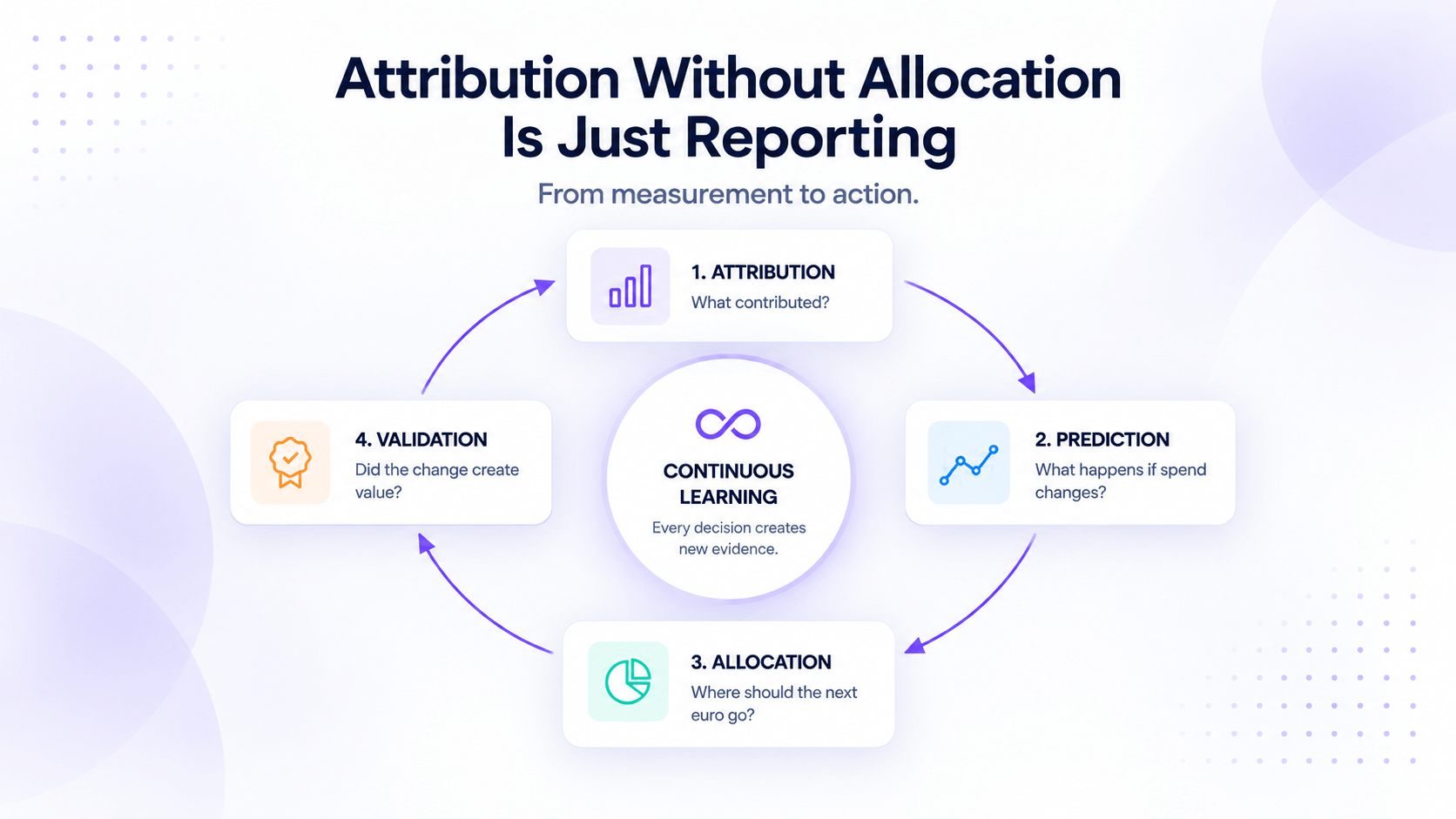
The four layers: attribution, prediction, allocation, validation
A lot of marketing measurement discussions mix different questions together, I think it is important to separate them.
- Attribution: what contributed?
Attribution helps estimate how channels and campaigns contributed to observed outcomes, it is fundamentally backward-looking. and helps us interpret what happened.
This matters a lot because platform/channel-reported numbers are not a neutral cross-channel number aka the source of truth. Google sees the world from Google perspective. Meta sees the world from Meta. But only your CRM/ERP/POS or data warehouse has the business outcome/revenue/CLV/etc. you actually care about. A good attribution layer creates a comparable view across channels and connects as closely as possible to that business outcome. - Prediction: what is likely to happen next?
This is where the question changes from past to future.- If we add EUR 10’000.- to a campaign, what should we expect happens?
- If we take EUR 10’000.- away, how much performance are we loosing?
Attribution credit alone cannot answer that, for this we need to understand response curves, diminishing returns / saturation effects, seasonality, conversion lag, and how performance changes at different investment levels.
- Allocation: where should the budget move?
Now we can ask the important question. Given one shared budget, multiple channels, business constraints, and predicted outcomes, which combination of investments is most likely to produce the best portfolio result and in what time?
That is an optimization problem and it is very different from optimizing Google inside Google, Meta inside Meta, or ranking campaigns in a spreadsheet by historical ROAS. Its also very important to understand there is an “optimal allocation” (which might give you your conversion in >+90 days) and there is a “short/long-focus allocation” (get all sales today, but loose the future potential or the other way arround). This is a business decision, not solely an attribution question, but prediction & allocation helps. - Validation: did the change create value?
Finally, we need to know whether our reallocation worked. Sometimes you are lucky and can run a randomized or geo-based experiment (i.e. we even did one with the University of Zurich ones or with Vodafone). In other situations, a modeled counterfactual (aka causal impact) can estimate what would likely have happened without the intervention.
The important point is, that one thing alone brings you nowhere, the whole thing is a closed loop:
Attribution -> Prediction -> Allocation -> Validation -> Better Attribution >. …
That is the operating system.
Attribution credit is not a budget plan
This sounds obvious, but it is still one of the most common mistakes I see many advertisers do in their daily business. If a channel receives 25% of attributed conversions, it does not mean that the channel should receive 25% of the budget 😉
Why?
Because allocation is about the future, which for sure is not like the past, and more importantly, the next unit of spend.
Average performance is not marginal performance
Example: A campaign can have an excellent ROAS at its current spend but will be a terrible place for another EUR 20’000. It may already be close to saturation (i.e. impression share is >95% or audience is exhausted for example)
Another campaign might show a slightly weaker average ROAS today but still have much more headroom and the overall performance would increase when investing the 20k there. So the better question is not:
- Which campaign performed best last month?
It is:
- Where does the next EUR 10,000 create the most value?
That small change in wording changes the whole optimization problem and the thinking about it.
Diminishing returns & saturations are not an edge case
Paid media does not scale linearly, thats obvious for most marketing experts. When ad spend increases, you reach less-qualified/good audiences, bid into more expensive inventory/keywords, increase frequency, or simply run out of demand.
Result: the response curve flattens.
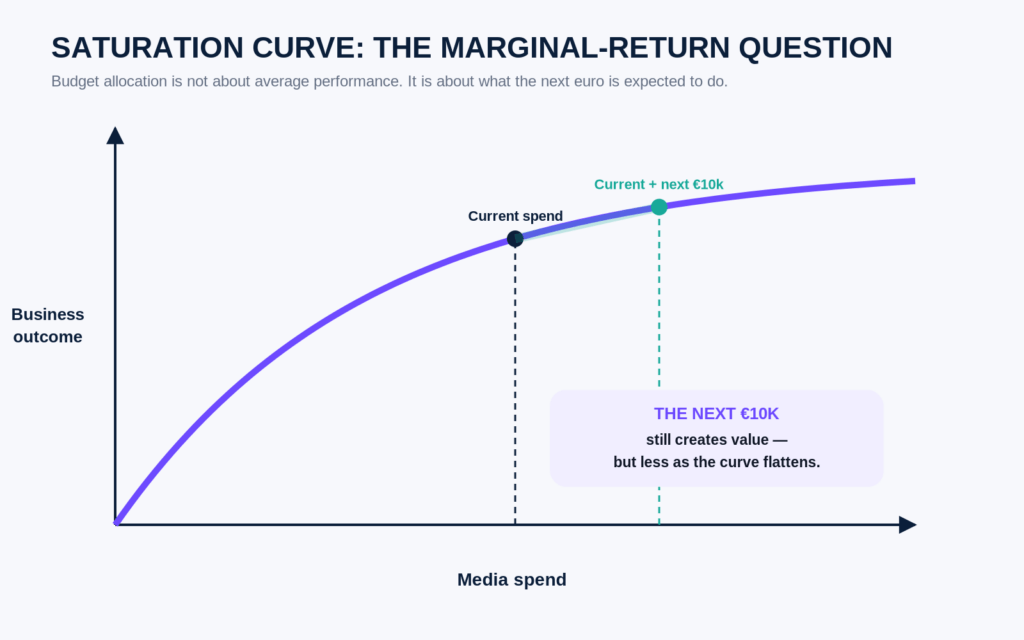
This is why static percentage allocations or historical ROAS rankings (this is always the best) are very dangerous. They ignore what happens when the investment level changes, competitor behaviour changes and even more, what happens with trends, seasonality, changes in behaviour of your audience, triggered by exogenous factors. (i.e. weather is a good example: suddenly everybody needs linen shirts because its hot, or a better car insurance because its hailing ;))
Real portfolios have constraints
But then reality arrives, a product launch needs minimum visibility (i.e. min budget). A market/geo has a fixed budget. A campaign cannot exceed a certain CPA because of tactic XYZ. Brand activity cannot simply be switched off just because. A retailer has margin differences across categories. A travel company has changing availability/capacity (i.e. think about airlines/transport/travel). An insurer cares about CLV/ALV outcomes, not cheap form fills / offer request.
The highest-return option calculated in your amazing attribution or media mix modelling, is useless if it violates your core business rules. Good optimization therefore needs both prediction and constraints (or in engineering words: guardrails and harnessing ;)).
The operating model has to change too
Better models alone do not fix slow budget allocation, you also need a way of working that allows money to move. I tried to simplify it into three principles.
1. Measure on a comparable basis
Before reallocating anything, understand what each signal means and what your most important signal is:
Perfect data does not exist, the goal is not to eliminate uncertainty. The goal is to understand it well enough to make appropriately sized decisions.
- Which outcome are you optimizing? (think: north star KPI, revenue/CLV etc’)
- Which data source has that outcome? (ERP/CRM?)
- Where is the conversion lag? (Not just from form> sales, but the whole customer journey?)
- Where are the tracking gaps? (Think pixel, consent, view-trough conversion)
- Which signals are comparable across channels?
2. Move continuously, inside guardrails
Most performance teams still treat cross-channel allocation as a monthly or quarterly planning exercise, where the teams or even partners (agencies per channel etc.) meet. But market conditions do not move quarterly, they move daily as well as your competitor. Example: Auction prices change, bid mechanism changes (think PMAX, OpenAI Ads etc). Demand changes. Competitors change. Promotions start. Products sell out/price changes. A channel that had great numbers two weeks ago may already be saturating.
The stronger operating model is continuous reallocation in controlled steps, not every change needs the CMO in the room. But: routine changes can happen inside agreed objectives and guardrails.
This is where I see the best division of labor between humans and AI:
Humans own:
- business objectives
- strategic priorities
- constraints and risk appetite
- market context
- new channel and product decisions
Machines/AI can own:
- continuous evaluation of campaign opportunities
- response prediction
- comparison of budget scenarios
- routine cross-channel reallocation inside approved rules
The machine is not replacing marketing strategy, it should replace a lot of spreadsheet work 😉
3. Validate and learn
Every meaningful reallocation should create a learning opportunity for the whole team.
- Did the additional spend create the predicted uplift? (measured with causal impact for instance)
- Did the campaign we reduced keep performance?
- Did the effect appear immediately or after a conversion lag / do we need to wait still?
- Is the result visible in the CRM, or only inside the ad platform?
This is where experiments and modeled counterfactuals matter, a randomized holdout/geo test or a stasticial causal impact gives very strong evidence when the setup is feasible. The key is to define validation before celebrating the result 🙂
The part most teams miss: optimization can improve measurement
This is the part I find most interesting, measurement and optimization are usually treated as two separate workstreams.
First the analytics team tries to determine “historic” contribution, then the performance team tries to act on it. But there is no feedback loop between the two.
If channel budgets barely move independently, statistical models have a hard time separating their effects (named as multicollinearity issue) . The data simply does not contain enough variation to distinguish what one channel is doing from another with high confidence, controlled budget changes create more informative observations.
That does not mean every weekly optimization is automatically a randomized experiment. It means that deliberate, bounded variation can help the model learn how performance responds when spend changes. This is one reason we think about weekly or bi-weekly budget shifts as micro-experiments.
Optimization creates new evidence, new evidence improves the model > Result: The improved model informs the next optimization. That is much more powerful than running attribution as a quarterly reporting exercise.
We have described the technical thinking behind this in more detail in our article on regression-based attribution and weekly budget changes.
For a CMO: this is capital allocation
At leadership level, I would stop talking about attribution models very quickly. The real issue is capital allocation, you have a limited marketing budget and many ways to deploy it.
So the questions I would want to answer are:
- Where are we already saturated?
- Where do we still have possibility to grow?
- What happens if the total budget goes up 10%?
- What should we cut first if it goes down 10%?
- Which conclusions come from attribution, and which have validation behind them?
- Which decisions can be automated safely?
- Where do we still need human judgment?
- How can we “fix” this month, by moving budget in short term vs. long term campaigns? (yes, sad but true, business first ;))
That is a much more useful conversation than arguing whether Meta, GA4, or the CRM has the “correct” number and it changes the role of the performance team. The team spends less time manually finding and implementing small allocation changes, and more time defining objectives, testing strategy, improving creative, entering new channels, and challenging the model when business context changes.
That is where we should have talented marketers spending their time.
Attribution without action is an expensive reporting exercise
The next generation of performance marketing will not treat measurement and optimization as separate disciplines.
- Every allocation decision creates new evidence
- Every new observation should improve the next decision
- Attribution helps us understand what contributed
- Prediction estimates what is likely to happen if spend changes
- Optimization turns that into an allocation decision
- Validation tells us whether the result was real
- Then the loop starts again
That is the shift I think matters most, not from last click to another dashboard.
But : from measurement to action.
If you want to see how Nexoya connects privacy-resilient attribution with predictive cross-channel budget optimization, take a look at the platform or talk to me and the team 🙂