
About ITA Airways
ITA Airways, 59% owned by the Ministry of Economy and Finance and 41% by Deutsche Lufthansa AG, is the Italian reference carrier, connecting more than 60 destinations worldwide. Operating from its main hub in Rome Fiumicino, the airline combines premium service and Italian hospitality with a strong commitment to sustainability.
With approximately 5000 employees and a fleet of 108 aircraft (as of September 2026) ITA Airways continues to invest in next-generation aviation technologies to support sustainable growth while delivering seamless travel experiences for both business and leisure travelers.
About JAKALA
JAKALA is the leading European player in AI-powered, data-driven performance.
The company operates as one integrated model, connecting strategy, technology, and data activation to deliver measurable impact across the end-to-end customer domain.
By structuring data, context, and decisions, JAKALA turns data and AI into actionable insights and measurable business outcomes. Its AI Factory scales this approach, industrializing the deployment of analytics and AI across clients’ organizations.
Founded in 2000 by Matteo de Brabant and backed by Ardian since 2021, JAKALA has grown through integration into an international organization with over 3,500 professionals, more than 1,000 clients, and a presence in over 40 countries. Headquartered in Milan, the company combines local expertise with shared capabilities across Europe and beyond, operating as One JAKALA with full accountability on results.
JAKALA integrates sustainability into its strategy and operations to drive responsible, long-term value for businesses, people, and the environment.
The Challenge: When Marketing Metrics Don’t Reflect Reality
ITA Airways operates performance marketing at scale across roughly 700+ routes and nearly 200 campaigns in 25 countries. While campaigns were already optimized using bookings and revenue data, a key limitation remained: these metrics do not fully reflect the airline’s real business outcome.
For airlines, understanding when passengers actually travel is just as important as understanding when they book. While revenue and bookings provide valuable performance signals, they do not fully capture future flown demand across routes and travel periods.
This raised a critical challenge:
How can an airline shift meda budget investment decisions and campaigns optimization from short-term revenue generation to the future travel demand that ultimately fills planes?
To answer this, ITA Airways and JAKALA set out to connect media performance with first-party flight and sales data, enabling a more accurate, demand-driven approach to optimization.
Key objectives:
Together, ITA Airways, JAKALA, and Nexoya set out to build a more advanced optimization framework with three primary goals:
- Predict future travel demand and identify the optimal timing for advertising budget deployment.
- Dynamically allocate media budgets across channels and routes to maximize return on ad spend.
- Integrate first-party sales and flight data into AI-driven predictive models to optimize toward completed travel rather than bookings alone.
The long-term objective was to create a unified AI-driven decision platform capable of predicting future demand, identifying the most valuable opportunities across routes and markets, and automatically recommending the optimal allocation of media budgets.
By combining campaign performance data with real business outcomes, ITA Airways and JAKALA aimed to move beyond traditional marketing optimization and establish a more direct and automated connection between advertising investments and airline performance.
The Solution: AI Optimization Based on Flown Data
To close the gap between bookings and actual travel, Nexoya worked with JAKALA and ITA Airways to build a tailored AI model trained on 2.5 years of flight and sales data.
How the Model Works
1. Learning from historical flight and booking data
The model analyzes 2.5 years of data to understand route-level demand patterns, seasonality, booking behavior, and the booking-to-flown relationship.
This enables a deeper understanding of not only where demand exists, but when it converts into actual travel.
2. Predicting demand across booking horizons
- 0–30 days: short-term demand (primary optimization focus)
- 30–90 days: mid-term demand
- 90+ days: long-term and seasonal demand
This allows ITA Airways to anticipate demand earlier and allocate budgets proactively.
3. Automated budget allocation across 20 routes
Budgets are continuously optimized across a portfolio of 20 routes based on predicted demand. Seasonality, holidays, and route-specific patterns are automatically factored into allocation decisions.
4. Continuous monthly learning
The model retrains every two weeks using updated flight and sales data, ensuring predictions remain aligned with evolving traveler behavior and market conditions.
Beyond Performance: A New Level of Business Insight
Beyond performance gains, ITA Airways gained new visibility into demand patterns, booking behavior, and route performance.
For the first time, flown data was directly and automatically integrated into paid media budget investments decisions, enabling more accurate forecasting, planning, and budget allocation across the business.
Key Benefits
Up to 58.63% More Short-Term Bookings Through Flown-Based Optimization
ITA Airways integrated first-party flown data into its optimization process, aligning media investments with actual travel outcomes rather than relying solely on bookings or revenue.
20 Routes with Clearer Demand Visibility Across Booking Horizons
The model improved visibility into booking behavior and demand patterns across routes and time horizons, enabling a deeper understanding of when and where travel demand emerges.
2.5 Years of Data Enabling More Accurate Budget Planning
By training on 2.5 years of historical sales and flight data, ITA Airways gained a stronger foundation for forecasting demand across short-, mid-, and long-term booking windows.
+8.56% Average Uplift in Bookings through Automated Route-Level Optimization
AI-driven budget allocation reduced manual effort while continuously directing spend toward the highest-potential routes based on predicted demand. As a result, this helped achieve an average uplift of 8.56% in bookings across all legs.
Bi-weekly Model Retraining for Continuous Performance Improvement
Regular retraining with fresh flight and sales data ensured predictions stayed aligned with evolving traveler behavior and market conditions.
Stronger Link Between Marketing Spend and Flown Business Outcomes
By focusing on the booking-to-flown relationship, ITA Airways achieved closer alignment between advertising performance and real business results, improving decision-making across marketing and commercial planning.
Future outlook
The 20-route test portfolio validated the model. The next phase is an active rollout – progressively expanding optimization to cover ITA Airways’ full route network. The ambition: replace standard budget optimization entirely with this first-party data-driven model across all 700+ routes.
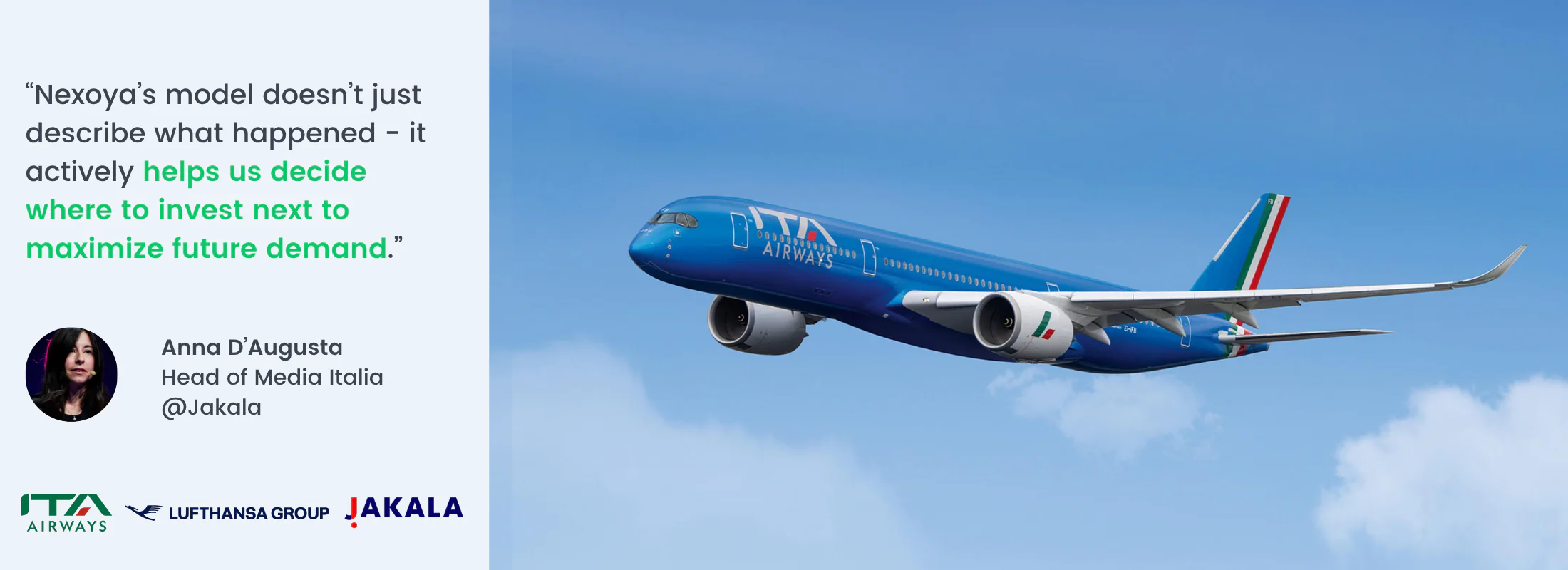
“With Nexoya, we were able to turn complex flight and sales data into actionable budget decisions. The model doesn’t just describe what happened – it actively helps us decide where to invest next to maximize future demand.”
Anna D’Augusta, Head of Media Italia at Jakala

Company
ITA Airways
Industry
Travel
Headquarters
Rome, Italy
Size
ca 5000 employees
Type
Public-private corporate airline
Optimized channels
Google Ads, Microsoft Ads, Criteo