


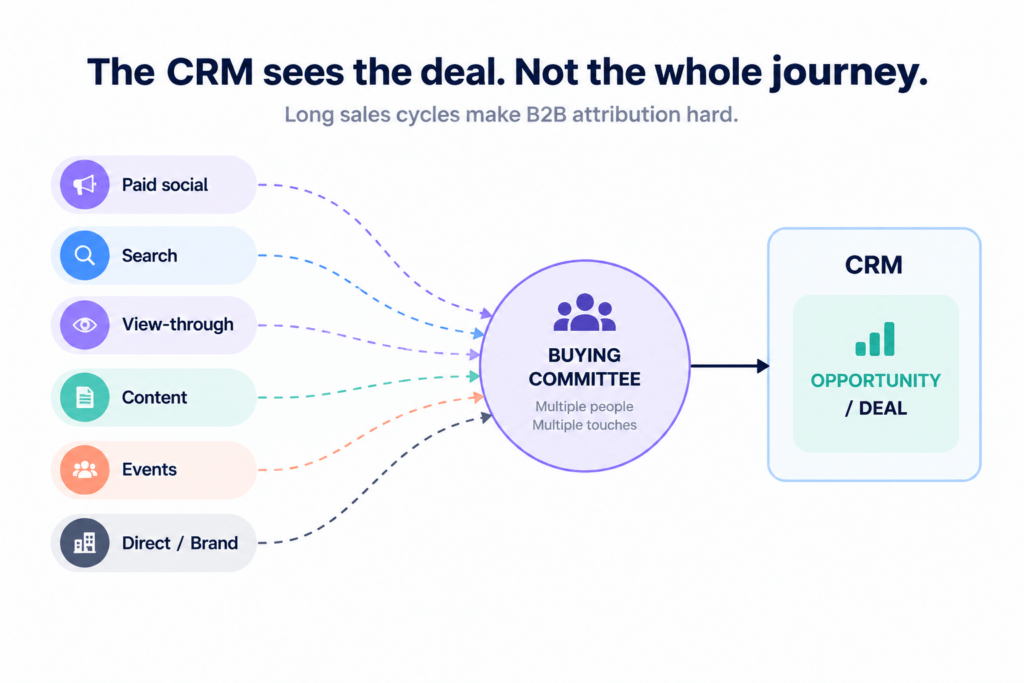
B2B attribution gets messy very quickly because the sales cycle is usually much longer than the tracking window, and the buyer is rarely one person. A user sees a LinkedIn ad today, someone else from the same company reads a blog post next week. There is a webina, sales reaches out, phyical events. Another stakeholder joins the process, two-four months later somebody searches the brand on Google, fills a form, and eventually an opportunity appears in Salesforce. Great 😉
Now the question is: which touchpoint actually created the opportunity?
Very often the answer becomes: the one we managed to capture cleanly in the CRM.
And that is exactly the problem. I wrote about the general issue in Attribution Without Allocation Is Just Reporting: measurement only becomes useful when it changes where the money goes.
In B2B, there is a significantly bigger challenge in the room: the buying journey is longer and most likely way more complex than any of your tracking journeys.
If you cannot see the early influence, it’s easy to cut the channels that created demand and keep funding the channels that happened to capture it at the end.
Your Salesforce/MS Dynamics is not wrong, but it just sees what you give it.
I hear this sentence quite often: “Salesforce says the opportunity came from Google.”
Maybe, but what does that really mean? Salesforce can support Campaign Influence, custom attribution models and more advanced setups, so saying “Salesforce is only last click” would not be correct. I mean its good to have the signal there, thats a great start 😉
But the real issue is simpler: the CRM can only attribute the marketing activity that arrives in the CRM in a usable format. If the setup uses a primary campaign source, one campaign can end up getting the full credit. More advanced influence models can distribute credit across several campaign touches. But all of them still depend on what was actually captured and connected to contacts, campaigns and opportunities. The CRM does not magically know:
- Every ad view
- Every anonymous website visit
- Every podcast someone listened to
- Every colleague who forwarded a deck
- Every offline conversation
- Every conversations of the last party/event
- Every stakeholder who researched the brand without filling a form
So I would not say the CRM is wrong, I would say it is incomplete unless you can feed it the journey, and in B2B that journey is extremely hard to capture.
View-through & word-by-mouth is probably the most painful part 😉
A lot of B2B marketing influence happens without a click. This is especially true for LinkedIn, video, display and other upper-funnel formats. Someone sees your ad five times, they never click. Later they search your company, visit directly, ask a colleague, or respond to a salesperson.
Did the ad matter?
Probably sometimes, yes.
Can the CRM prove it?
Usually not. Ad platforms try to solve this with view-through attribution windows. LinkedIn can report view-through conversions. Google can do the same for eligible display/video activity. Meta also has its own view-through logic.
Useful? Yes.
One cross-channel source of truth? No.
Because now LinkedIn sees LinkedIn, Google sees Google, Meta sees Meta, and Salesforce sees what reached Salesforce. Everybody has a piece of the journey, and everybody can show you a number that looks reasonable 😉 The B2B marketer still needs to decide where the next 100’000 Euro should go, That is where platform attribution becomes dangerous for allocation. Plus, its well known and stated many times by many studies, that the AVERAGE amount of touches with your brand is around 16 in B2B, so thats a massive task for marketing to support that.
Long sales cycles break the feedback loop
This is probably the biggest B2B challenge, the actual outcome may arrive months or even quarters after the first media touch. A simple B2B funnel might look like:
- Impression
- Website visit
- Content engagement
- MQL
- SQL
- Opportunity
- Proposal
- Closed won
And there can be weeks between every step, if we wait for closed-won revenue before adjusting every budget, we move too slowly. If we optimize only toward MQLs because they arrive quickly, we can create the opposite problem: a lot of cheap leads that sales does not want. So in that sense: the fastest signal is not always the best one!
You need a leading indicator that arrives early enough to operate the media, but it still needs to correlate with the business outcome you actually care abouut. For one B2B company this could be:
- Sales-accepted leads
- Qualified opportunities
- Pipeline value
- Closed-won revenue/ACV/LTC
- Account-level engagement
For another, a good MQL might still work if the conversion to opportunity is stable enough and you monitor it (even more important!). The important thing is not the label, important is that you keep calibrating the early signal against the downstream result.
Buying committees make person-level attribution fragile
The other big B2B problem: the buyer is usually not one person, the person who sees the first ad may not be the person who fills the form. The person who joins the webinar may not be the economic buyer, the person who signs the contract may never have clicked an ad in their life or maybe 10 times 😉
One deal can involve:
- Practitioner
- Team lead
- Procurement
- IT/security
- Finance
- Exec sponsor
- Goodfather of the exec 😉
Trying to reconstruct one perfect person-level journey across all of them sounds great in a slide deck. In reality, it becomes fragile very quickly because of devices, consent, anonymous research, offline touchpoints and sales activity that ad platforms never see and here we only talk about digital. This is why I think the more useful question is not:
- Can we perfectly reconstruct every buyer journey?
It is:
- Can we estimate which marketing investments contribute enough to the business outcome to make a better budget decision?
For me, that is much more practical.
Don’t confuse demand capture with demand creation
This is where B2B budgets can get distorted very quickly, imagine LinkedIn creates awareness and demand over six weeks. The buyer never clicks. Later they search your brand on Google, fill a form, and the opportunity ends up connected to Search. Google looks fantastic, linkedIn looks expensive. The obvious “performance” decision becomes:
- Cut LinkedIn.
- Add budget to Search.
A few months later branded search volume drops, pipeline weakens and everybody wonders what happened. The mistake was not investing in Search. Search is great at capturing existing intent, the mistake was assuming demand capture and demand creation are the same thing and guess what: they are not.
In B2B the creating touch and the converting touch can be separated by weeks or months, which makes this problem especially painful.
Budget allocation needs one business outcome, even if the journey is incomplete
This is why I would not try to solve B2B attribution by creating the “perfect” click path first, because you may never get there.
Instead, connect media activity as close as possible to the business outcome and use aggregated patterns and early signals, where user-level tracking is incomplete.
For example, ask:
- What happens to qualified opportunities when spend changes in LinkedIn?
- What happens to pipeline when upper-funnel video increases?
- What happens to branded search after a campaign starts?
- Which media investments consistently lead to more downstream value, even if the individual user path is incomplete?
This is where regression-based and aggregate approaches become interesting because they do not require the perfect identity stitch for every user. This is also why we built Nexoya Attribution around aggregated performance and first-party outcomes. (Yes, here is the some tool mentionding here ;), but it solves a very real problem in B2B setups.) How Nexoya Attribution works
The goal is not to remove uncertainty, the goal is to make a better budget decision despite the uncertainty.
What should a B2B team optimize for?
I would start with the deepest business outcome that is still useful operationally. For a high-volume business, this might be closed-won revenue, for an enterprise setup with a 9-month sales cycle, that is probably too slow. Then maybe qualified opportunities or sales-accepted leads are the better leading signal. The key is to understand the relationship between the early signal and the final business value.
I would separate questions like:
- What allocation maximizes qualified opportunities this quarter?
- What allocation maximizes expected pipeline value?
- What happens if we reduce upper-funnel spend by 20%?
- Which channels are mostly capturing demand vs. creating it?
- Where do we still have headroom?
- If sales says MQL quality dropped, which campaigns caused it?