
We all know the challenge.
Multiple dashboards, inconsistent data, and fragmented customer journeys make it harder than ever to understand what truly drives performance. At the same time, tracking signals are declining, last-click models miss the full journey, and traditional MMM cannot keep up with the speed modern marketing teams require.
The result? Decisions based on partial truth rather than real insight.
That’s why we’re so excited to introduce Nexoya Attribution, built to deliver unbiased, actionable clarity across every channel and empower your team to make proactive, data-backed decisions. No pixels, no waiting, no guesswork.
What Is Nexoya Attribution?
Attribution is the practice of understanding which marketing channels, campaigns, and interactions drive conversions along the customer journey. It answers a simple question: what is actually working?
For years, marketers relied on deterministic attribution – tracking individual users across touchpoints using pixels, cookies, and multi-touch models. But as privacy regulations tightened (GDPR, iOS restrictions, cookie deprecation) and consumer behavior grew more complex, these methods became increasingly unreliable. Today, a single real-world conversion can be claimed by multiple platforms simultaneously, leading to inflated numbers, conflicting reports, and decisions made on data nobody truly believes.
Nexoya Attribution solves this with a fundamentally different approach. Instead of chasing individual user signals that are increasingly unavailable, Nexoya uses regression-based, probabilistic attribution – the same statistical methodology behind advanced Marketing Mix Models (MMMs), applied at the campaign level, in real time, and without relying on cookies or pixels.
The result: clear, trustworthy attribution insights that tell you which channels and campaigns are driving incremental business results – and a system that gets smarter every week you use it.
How Nexoya Attribution Works
Nexoya uses regression-based attribution (RBA) – a lightweight, privacy-safe adaptation of the statistical techniques used in traditional Marketing Mix Modeling. The regression model runs on a monthly cadence, using weekly budget adjustments as ongoing micro-experiments to continuously learn and improve accuracy.
Here’s how it works in practice:
1. Data ingestion
Nexoya pulls all performance data (impressions, clicks, sessions, etc) from all your connected ad platforms daily, alongside your actual business results – leads from your CRM, revenue from your Shopify store, account creations from your data warehouse, or any other conversion KPI you define.
2. Statistical regression
The model runs a regression analysis to find statistically significant relationships between your media activity at the campaign-tactic level and your real downstream results.
3. Attribution factors
The model outputs a factor for each campaign type (e.g., Meta Retargeting, Google Search Brand, TikTok Prospecting) that defines its true impact on your conversion KPI. For example: 1,000 impressions from a specific Display tactic may have a measurable, attributable effect on 1 downstream account creation.
4. Continuous improvement through micro-experiments
Every week, Nexoya’s optimization engine shifts budgets. These budget changes alter impression volumes across campaigns – and those changes become the variation the statistical model needs to improve its accuracy over time. The monthly regression model uses these weekly variations as its ongoing experiment inputs. You don’t need to run costly manual experiments. The regular optimization process is the experiment.
5. Attribution-informed optimization
The attribution factors feed directly into Nexoya’s prediction engine. Budget proposals and scenario simulations are built on attributed outcomes – not publisher-reported numbers – so budget can be shifted confidently across channels using a single, consistent measure of impact – rather than relying on each channel’s own, incompatible reporting.
Key concepts explained
Attributed vs. Measured
Inside the Nexoya platform, you’ll see two key numbers side by side for each channel and campaign:
- Measured: The conversions or revenue reported by the publisher’s pixel (e.g., what Meta claims it drove) or your analytics platform (e.g., what GA4 reported). You can define the current “measured” source you’re looking at.
- Attributed: The conversions or revenue Nexoya’s regression model has calculated as the incremental contribution of that channel.
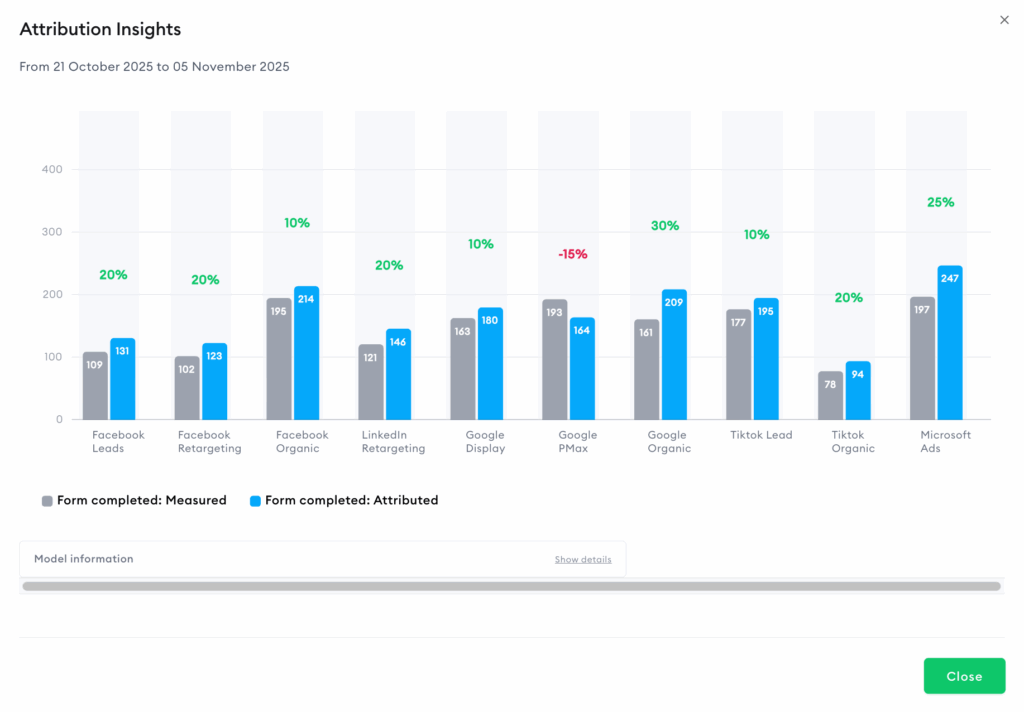
These numbers will rarely match – and that’s the point. In practice, you may find that a channel your pixel credits with 400 leads is actually responsible for around 280 when statistically modeled against your real CRM data. Equally, a channel like display or DOOH that appears to drive zero measurable conversions may have a meaningful attributed contribution.
Baseline vs. Incremental impact
Nexoya separates your total business results into two components:
- Baseline: Sales or conversions that would happen regardless of paid advertising. This includes factors such as organic brand awareness, offline advertising, direct traffic, word of mouth, affiliate and partner channels, as well as other non-digital or non-trackable touchpoints. Calculated simply as: total CRM results minus attributed results.
- Attributed: The portion of your results that can be assigned to digital advertising activities based on the attribution model.
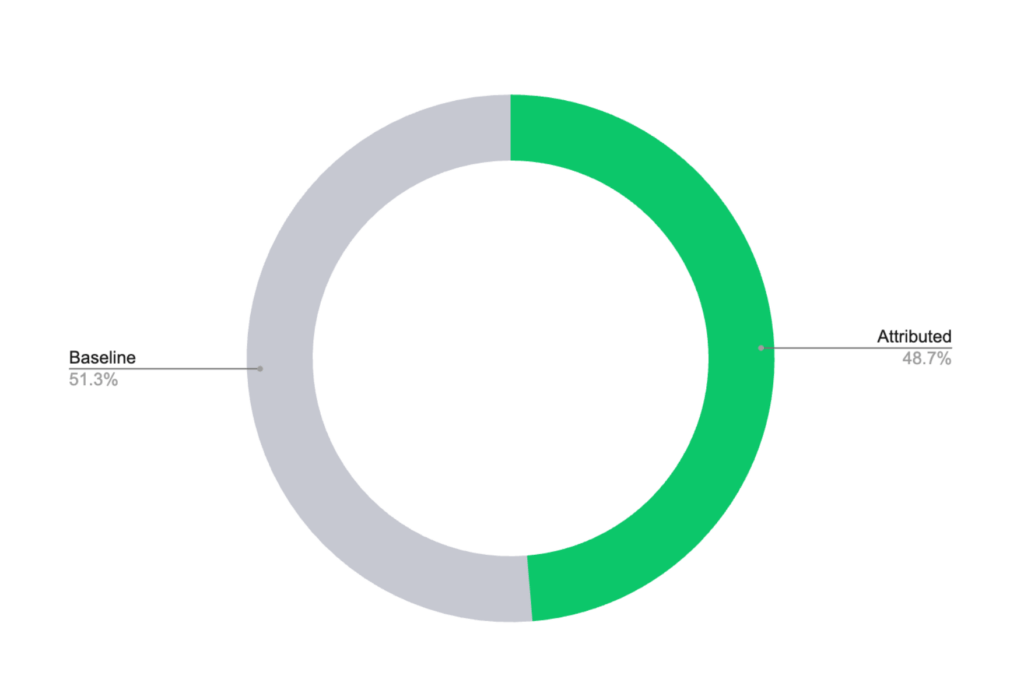
This distinction is important. An e-commerce brand heavily dependent on performance advertising might see 60% of revenue attributed to paid media. An established insurance brand with strong brand recognition might have a much higher baseline. Understanding this split helps you manage expectations and make smarter investment decisions.
Nexoya Attribution in Practice
Proven results: Generali, a leading insurance brand, achieved +18.8% more online leads after implementing Nexoya Attribution to move from fragmented multi-platform reporting to a single, regression-based source of truth across their digital channels. Their approach was presented at DMEXCO and is available as a detailed masterclass replay.
Frequently asked questions
Is Nexoya attribution the same as a Marketing Mix Model (MMM)
No – and this distinction is important. Nexoya applies the same regression techniques used in MMMs, but at the campaign and ad set level, for digital channels only, and with a very different output: weekly actionable recommendations for performance marketing teams. An MMM is designed for analytics or BI teams analyzing historical strategic performance (e.g., “was our TV investment last year worth it?”). Nexoya answers a different question: “how should we allocate budget across our digital campaigns next week?”
If you already have an MMM, Nexoya is complementary – not a replacement. Keep your MMM for board-level strategic reporting; use Nexoya for weekly performance management.
How is Nexoya Attribution different from the attribution I already get from Meta, Google, or TikTok?
Platform-reported attribution is self-reported, and every publisher has an incentive to claim as much credit as possible – which is why one real conversion often gets counted by three different platforms. Nexoya uses your actual CRM or transaction data as the source of truth and statistically models which media activities drove which outcomes, independently of any publisher pixel.
What can be attributed with Nexoya?
Nexoya Attribution is designed for biddable, digital media – the channels where Nexoya can both measure and actively shift budget.
What Nexoya attributes:
- Paid social (Meta, TikTok, LinkedIn, Pinterest, Snapchat, X/Twitter)
- Paid search (Google Ads, Microsoft Ads)
- Programmatic display and video (DV360, AdForm, etc.)
- YouTube and online video
- Digital out-of-home (DOOH)
What Nexoya does not attribute:
- TV, radio, and print (these cannot be optimized via budget shifts)
- Affiliates and influencers (no dynamic budget shifts possible)
- Organic channels (SEO, organic social)
However, offline and non-biddable media can be incorporated as Special Events in the platform. If your brand runs TV campaigns regularly, those campaign periods can be imported as events, allowing the attribution model to account for their effect on baseline performance – without misrepresenting them as optimizable media.
Is Nexoya attribution right for you?
Nexoya attribution works best when you have:
✅ 24 months of daily historical data – the statistical minimum for the regression model to detect reliable patterns across campaign types and seasons
✅ Active spend across at least 3 channels – cross-channel exposure is what makes regression-based attribution meaningful and statistically reliable
✅ A CRM or first-party conversion metric – account creations, leads, purchases, or revenue from your own data source (not platform pixels)
✅ Upper or mid-funnel campaigns – attribution is most valuable for brands with brand-building activity, not purely bottom-funnel transactional search
✅ Autonomy over budget allocation – Nexoya’s optimization loop requires that budget can actually be moved between campaigns and channels based on recommendations
❌ Not a good fit: purely transactional, low-funnel businesses where every sale comes from direct branded search – attribution adds less value when there is no cross-channel journey to model
If your organization already has an MMM, Nexoya doesn’t replace it. They operate at different layers of the decision-making stack and serve different teams with different needs.
Can I use attribution if I operate in multiple regions?
Yes. Nexoya supports regional attribution splits, allowing you to distinguish how the same campaign type performs across different markets. For example, a Google Performance Max campaign might behave very differently in the UK versus the US – because brand awareness, audience demographics, and even channel habits vary by market. With regional attribution, budget can be moved across markets based on each region’s attributed performance.
Can Nexoya measure the impact of digital advertising on in-store (offline) sales?
Yes, for brands with retail locations and access to point-of-sale data, Nexoya can attribute digital media activity to both online and offline sales outcomes. This requires sharing store-level sales data in a structured format. The model can then distinguish, for example, that one third of new customers driven by a Meta campaign walked into a physical store rather than converting online – a metric that most digital performance teams have never had visibility into before.
What are the data requirements for attribution
To ensure reliable results, Nexoya Attribution requires:
- At least 24 months of historical data
- Consistent, structured performance data
- A clear business KPI (e.g. leads, sales, revenue, account creations)
The model needs enough data points to cover seasonality and long-term patterns. Without sufficient data, statistical modeling becomes unreliable.
Would you like to explore the new Attribution feature? Reach out to your Customer Success Manager to define the next steps.
New to the tool? Schedule a 30 minute attribution fix session with one of our experts.
It is time to move from data chaos to clarity you can trust.