



A telco can sell five very different things at the same time: mobile plans, devices, fiber, TV and not to forget the bundles, and maybe prepaid in one region and premium postpaid in another. Then we open the marketing paid dashboard and ask for one KPI: usually it is CPA, great 😉
The problem is that one blended CPA makes the portfolio look much simpler than it really is. Wrote about the general allocation problem already in Attribution Without Allocation Is Just Reporting. In telco, there is another layer: you are not really optimizing one funnel, but you are optimizing a portfolio of products with different values, different churn, different conversion paths, different regional differences (i.e. switching cost/likelyhood) and different strategic importance. If you reduce all of that to one average number, you can become very efficient at selling the wrong mix.
The problem starts with one average
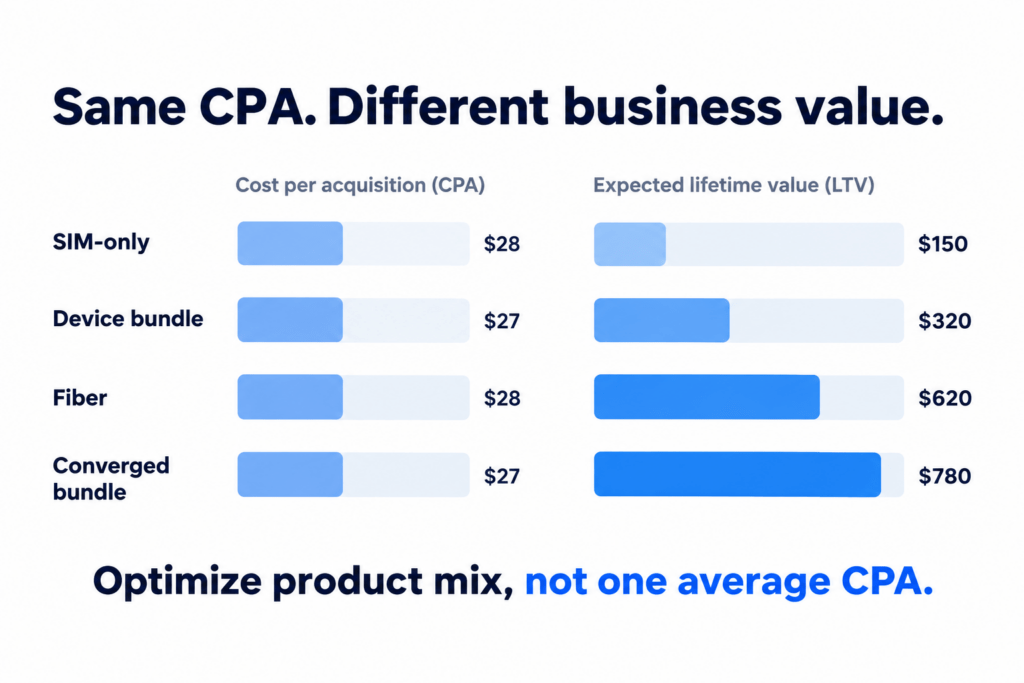
Imagine four products:
- mobile
- fiber
- a device bundle
- a converged bundle with mobile + internet + TV
Now imagine all four come in at around EUR 30 CPA, looks easy. Same cost, same result, right? Not really. Maybe the SIM-only product brings EUR 150 expected lifetime value (CLV/ACV). Maybe fiber brings EUR 600. Maybe the converged bundle has the strongest retention and reaches EUR 800+ expected value. Suddenly the same CPA tells you almost nothing about where the next euro should go.
This is why I would not start with „what is our acquisition cost?“ in telco.
I would start with:
- What is one additional sale of this specific product actually worth to us?
That can include:
- Expected revenue
- margin
- Contract duration
- Churn probability
- Upsell potential
- Bundle value
Once you have that, CPA becomes useful again. Without it, CPA is just one side of the equation.
Telco is not one funnel
The second issue is that the customer journey is very different by product and often your brand is very well known. A SIM-only mobile plan can be a relatively fast decision, fiber can be completely different: coverage matters & installation matters. The customer may compare providers, check availability, talk to the household, come back later, maybe call support and finally convert weeks later.
A device bundle again behaves differently because the device launch itself can create demand. So if all products use the same attribution assumptions, conversion windows and optimization logic, you are already simplifying quite a lot. This is why I like to think in product families first, not in channels first.
The question is not:
- Which channel is best for my product?
It is:
- Which channel x product combination still has the best expected marginal value? (or whatever metric you like ;))
That is a much more useful question.
Now think about regions, and it gets even more interesting
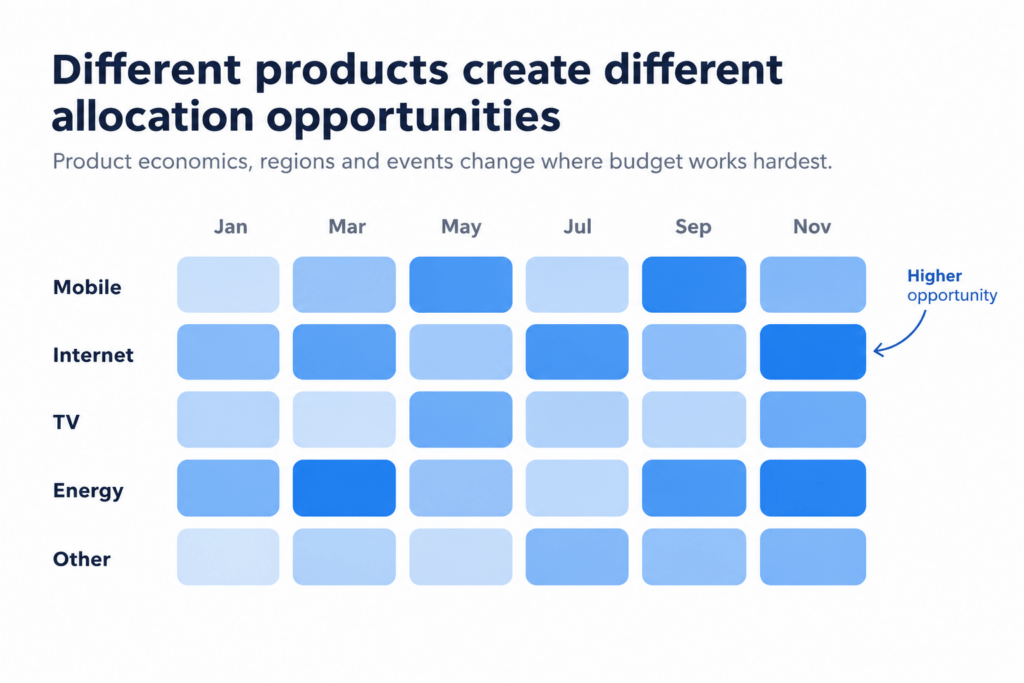
Network quality is not the same everywhere (G5,G6…). Competition is not the same everywhere. Brand strength is not the same everywhere. Fiber availability is definitely not the same everywhere 😉 . So the same campaign can behave very differently depending on the region, a national average can hide this very nicely. Even more if its across language regions. One strong region can make a campaign look healthy while another one is burning budget. Or one region may look expensive on CPA, but the contracts there are more valuable.
In practice, the useful unit often becomes something like:
- product x region x channel
And yes, this gets complex quickly. But this is also exactly where the budget allocation problem becomes interesting, because now you are no longer choosing between Google, Meta and Tiktok. You are choosing between hundreds of possible combinations of product, region and channel.
A spreadsheet can obviously do that, technically and with ChatGPT/Claude/Copilot even faster, but your weekend might suffer though 😉
Switching behaviour also changes the media mix
There is another regional difference I would not underestimate: customers do not switch operators at the same rate in every market!
That matters because the size of the actively switching audience changes how much demand you can simply capture versus how much preference you need to build first:
- Switzerland is a good example (spoiler: was working 10 years at Swisscom ;)) . The market is not all low churn, but it is very sticky in some segments. A 2025 bonus.ch survey found that 25% of German-speaking Swiss had changed mobile provider in the previous two years, compared with 20% in French-speaking Switzerland and 18% in Italian-speaking Switzerland. At operator level the difference is even larger: 85% of surveyed Swisscom customers had been with the provider for more than five years! Compared with 56% for Sunrise and 48% for Salt. The market structure points in the same direction.
- Italy looks very different, the AGCOM recorded 7.7 million mobile-number-portability operations between September 2023 and September 2024, with a 14.5% mobility index! Or Oliver Wyman’s 2024 European telco study found that 27% of Italian consumers were likely to change mobile operator within the next two years.
- Germany on the other side, as a market where traditional operators were showing more resilience against the move to low-cost players (OliverWyman article)
These numbers are not perfectly comparable actual switching, number portability and switching intention are different measures but they make one thing clear: switching dynamics are a market variable, not a universal constant. And this changes how your should think about media allocation depending on market, product, region.
In a very promotion-driven market with many active switchers, performance media can harvest a lot of existing demand. In a stickier market, or when you are trying to win customers away from a strong incumbent, fewer people are actively shopping at any one moment. If you only show up when they finally search for „best mobile plan“, you are very late in the game. So in those markets give more weight to brand, consideration and repeated reach. Not because brand is somehow separate from performance, but because brand increases the future pool that performance can convert later.
Product launches and promotions can flip everything overnight
Telco is also full of commercial events that change the economics:
- iPhone or Samsung launch
- Tariff promotion
- Fiber rollout
- Black Friday
- Back-to-school offers
- Competitor dropping prices/entering market
- Bundle push
- Regional sales campaign
Historic data is still important, obviously. But historical data does not know next week’s commercial plan unless you tell the system. This is why I would separate two inputs:
- What the model learned from past performance
- What the business already knows about the future
If the business knows a device launch starts next Monday, or that fiber becomes available in another region, I do not want to wait two weeks for the model to „discover“ it after the money is spent. The business context belongs in the decision.
Platform optimization is useful, but portfolio optimization is different.
Google can optimize Google very well, Meta can optimize Meta very well, Tiktok can optimize Tiktok very well. But none of them is responsible for your total telco product mix Google does not know that the business urgently needs more fiber contracts this quarter. Meta does not know that churn makes one mobile offer less valuable. Tiktok does not know that one region has much higher lifetime value.
They optimize locally, you as an advertiser in Telco have to optimize globally. That means one comparable business outcome and one shared view of the total portfolio. Otherwise you end up with several local optimizers, all proving why they deserve more money 🙂
What I would actually optimize in telco
If I ran the portfolio, I would not ask for one universal KPI. I would define the business value per product family x region first. Then I would look at where the next budget increment creates the best expected result.
A very simplified version could be: Expected value per region = expected sales x value per sale – media cost
The real model can obviously be more sophisticated, but the logic is the important part. Then I would ask:
- Does this product still have opportunity to grow?
- Is the region attractive?
- Are we close to saturation? (including likelyhood of switching..)
- Is there a launch or promotion changing demand?
- Does the budget move improve the total product mix?
This is much more useful than saying Campaign A has CPA 27 and Campaign B has CPA 29, so A wins.
Vodafone Italia: test the allocation instead of debating it
Vodafone Italia is one of my favorite examples because they actually tested the cross-channel allocation instead of arguing for months about whose model looked better. They ran a six-week comparative A/B test across Google Ads, Meta and DV360.
The published result was:
- +13% sales uplift
Even more interesting: Nexoya’s general model was compared with customized machine-learning models built by multiple experts, and the general model delivered the stronger uplift. I like this because it is exactly how these discussions should be handled.
Not: „I think our internal model is better.“
But: „Great, let’s test it.“
Read the Vodafone Italia case study
A simple sanity check before I move telco budget
Before moving budget, I would check six things:
- Are we measuring the real value by product, or only one blended conversion?
- Are products with very different economics competing under the same CPA target?
- Do regional differences matter enough that we should split the logic?
- Is there any product launch, promotion or commercial event that changes the next few weeks?
- Which products and campaigns are already close to saturation?
- Does the reallocation improve the total business result, or only one platform number?
If these questions are answered, most telco allocation discussions become much more concrete.