



Travel and mobility have one very obvious problem: customer demand is moving all the time; it is not just seasons it’s travel behavior trends and changes, geopolitics, global warming, etc. For example: a route suddenly becomes popular, another destination is almost full, a train/plane or ship has plenty of seats left. A competitor changes prices to win certain regions. But also simple things like weather changes, school holidays start, an event happens in a city, and demand jumps within a few days.
And sometimes the media budget still looks exactly like it did when somebody planned it one month ago 😉
This is where budget allocation in travel and mobility gets interesting. The media opportunity is not only about which campaign converts best, but also whether the business can actually use more demand in that place, route, product, or period. I wrote about the general problem in Attribution Without Allocation Is Just Reporting: measurement only becomes useful when it changes where the money goes.
For travel and mobility, there is very different element on top: the value of every additional booking changes with demand and capacity!
So a campaign can look very efficient but should be stopped, because there is no capacity anymore..
More demand is not always more value
To an example, imagine two routes.
- Route A is already 92% booked
- Route B is only 60% booked
Both campaigns targeting this routes have the same CPA, where should we put more budget?
If we only look at CPA, both could look equal for example. But the business value of another booking can be much higher on Route B because there is still real capacity to fill depending on your business goals.
The same logic about capactiy applies to:
- Hotel rooms
- Flights (depending on your capacity team & pricing team obviously ;))
- Trains
- Car rentals
- Regional offers
- Destinations
This is why optimize travel media only against a „generic conversion metric“ is very dangerous towards your business goal. A model should understand what the business wants to fill or sell right now and what capacity there is to fit the demand. So don’t just think about revenue, it could be bookings, occupancy, margin, margin-per-capacity or even future value of sales-to-seat (i.e. sale>fly).
The key challenge remains the same: start with the business outcome and then work backward to the media KPIs.
Capacity changes your value of the next euro
This is where the travel industry significanlty differs from many other media setups. In ecommerce, inventory matters and price obviously. In travel and mobility, capacity can be even more time-sensitive because unsold inventory often expires. But this obviously has a different meaning if you’re the only provider of a certain route/destination or if there are many, then pricing can change everything. Again some example:
- An empty train seat today cannot be sold next month
- An unused hotel room tonight is gone forever
- An empty plane is very expensive to fly around
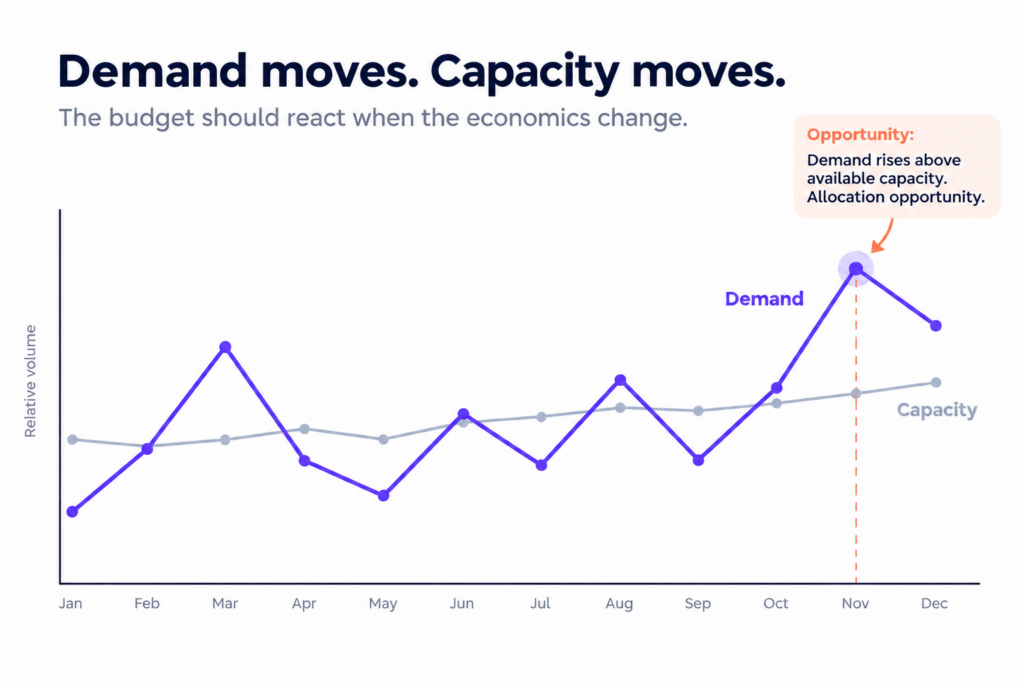
That means marketing value can change quickly depending on remaining capacity, if demand is already above capacity, spending more may only make clicks more expensive without creating much additional business value. If there is a weak route or period with lots of available capacity, additional media can be much more useful.
So the useful question becomes:
- Where does the next 10’000.- Euro create demand that the business can monetize (still ;)) ?
And this is a very different question from „which campaign had the best ROAS yesterday?“. Example of capacity vs. opportunity vs. demand.
Plus: Geography makes the portfolio much more complex
Travel and mobility are naturally geographic; different cities, routes, countries, or regions can have completely different economics at the same time. You may have:
- Srong demand in Zurich but weak demand in Geneva
- One destination close to full capacity while another still needs bookings
- Very different CPCs across regions
- Different competitor pressure
- Different lead times (search > to buy)
- Different order values (or even ACV/LTVs due to purchase power)
- Different local promotions and currency impacts
If all of that is grouped into one „average“, the useful signal disappears completly.This gets complex quickly. If you have 200 campaigns across multiple platforms and dozens of routes or markets, nobody wants to manually calculate all combinations in Excel every morning
That is exactly where automated optimization becomes useful, as long as it understands the business constraints.
Booking windows matter because the signal arrives at different speeds
Another challenge is timing : A person might see an ad today and book immediately. Or even more likely, they might research for two weeks, compare prices on multiple devices, talk to somebody, compare on priceing pages, come back through branded search and book later.
For some travel products, the feedback loop is fast, but for others it is much slower and this changes how quickly you can trust a campaign signal. If you move budget based only on yesterday’s bookings, you may overreact to noise or very short trends. If you wait until every customer journey is fully complete, you move too slowly. So yizr model needs to understand conversion lag and use the right leading indicators including trends and signals from you (i.e. pricing capacity) and the market.
The question becomes less:
- How many bookings did meta report yesterday?
And more:
- Based on what we know today, what revenue / bookings do we expect if we add budget to this route/campaign now?
And to be clear: this is a prediction, not attribution.
Seasonality is not only a yearly calendar
Everybody in travel understands seasonality very well and I was able to learn a lot from them. Summer is different from winter, weekends are different from weekdays, school holidays matter and are different per region, christmas matters etc.
But the interesting part is the unexpected seasonality inside the planned seasonality, demand changecan significantly and abruplty because of:
- Weather
- Events (think like concert, sports or even DMEXCO ;))
- Strikes (ok depending on country :D)
- Competitor behaviour (aka pricing, ad pushed)
- Trends/viral destination
- Airline schedule change
- Capacity being added or removed
- Local promotion
A static seasonal plan cannot react well to this, this is why the yearly plan is gerat for a starting point and then continuously adjust the portfolio as demand and capacity move. The media plan should be a hypothesis, not a „silo-prison“ 😉
One shared budget matters even more when channels capture different parts of demand
Google/Bing often captures existing intent very well. Meta, YouTube, display or other channels can create/reinforce demand earlier. Programmatic can support reach in certain markets, retargeting can bring people back later we all know that. And, if every channel gets evaluated only on its own platform attribution, you can easily overfund the channels that capture the final booking and underfund the channels that created the demand.
This is the same problem described in the general attribution article mentioned, but in travel it becomes very visible because booking journeys can cross many touchpoints and devices. The advertiser needs one comparable business outcome across the channels, otherwise Google tells you Google is great, Meta tells you Meta is great, and your CRM/booking system tells you the revenue. Everybody is technically correct in their own world 😉
What does this look like in practice?
Italo: optimize the business objective, not just the campaigns
Italo manages more than 200 campaigns across Google Ads, Criteo and Microsoft Ads, and the team wanted to improve performance while reducing the manual optimization effort. What I like about the case is that they didn’t have a single fixed objective. Depending on seasonality and business needs, the team could optimize for revenue or website traffic.
The published result was:
- +15% total revenue uplift
The interesting part isn’t just the uplift, it is the flexibility to change the optimization focus when the business priority changes. That is much closer to how travel actually works.
The questions I would ask before moving budget
For a travel portfolios, you can simpe ask:
- What is the final business outcome we really care about: revenue, bookings, occupancy, leads, or something else?
- Where do we currently have capacity or inventory that marketing can still help fill?
- Which markets/routes have very different economics that should not be hidden inside one average?
- How long is the conversion or booking window?
- Which upcoming events can change demand but are not visible in historic data yet?
- Where are campaigns already close to saturation?
- How will we validate whether the reallocation improved the total portfolio?
If these seven questions are clear, budget allocation becomes much more practical, and the AI model will be very focused on achieving the best possible business outcomes. You stop asking which channel won yesterday and start deciding where the next euro has the most business value today, driven by the best possible AI calculations 🙂